 Ektaya
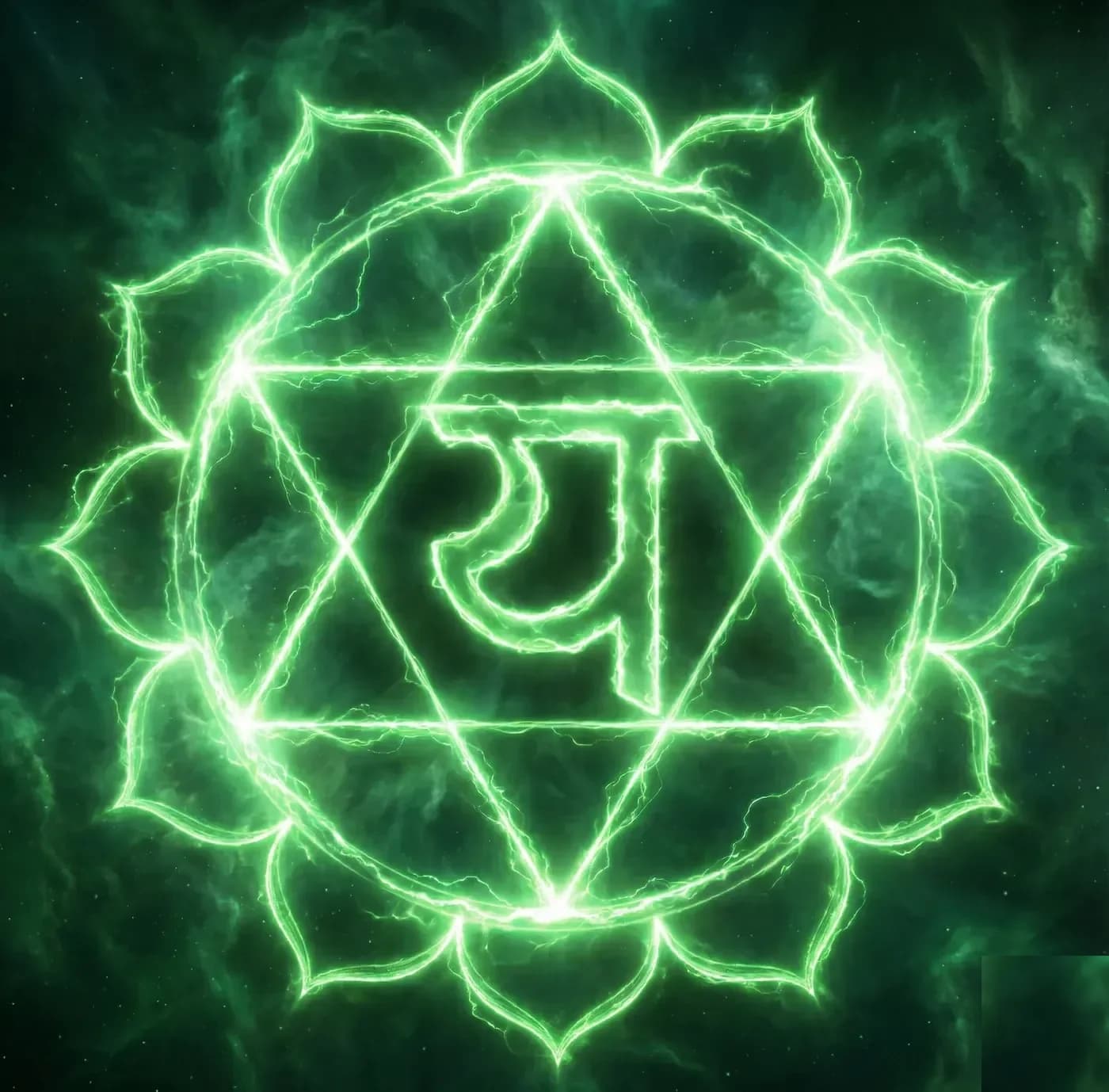
Anahata, the heart chakra. Your center of unconditional love, compassion, and balance.
Located in the center of the chest, at the level of the breastbone, the Heart Chakra, or Anahata in Sanskrit, is the fourth main energy center. Its beautiful name means “unstruck,” “unhurt,” or “the sound that is not made by two things striking together.”
Chakras are an idea from the yogic traditions, a way of describing inner experience. They are not an anatomical fact, and they are not linked to any illness. In that tradition, Anahata is the turning point, the central hinge of the chakra system. It acts as a bridge between the three lower chakras (tied to the material world and the ego) and the three upper chakras (tied to the spirit and intuition). This is where awareness rises from survival toward universal love.
Symbolism and Correspondences
In the yogic tradition, Anahata is pictured as a soothing emerald-green lotus with twelve petals. At its center is a hexagram (a six-pointed star made of two interlocking triangles) that stands for the Air element (Tattva Vayu) and the perfect union of rising and descending energies.
- Location: Center of the chest, breastbone, the heart and lung area.
- Color: Green (balance, renewal, growth), sometimes paired with pink (tenderness).
- Element: Air.
- Bija mantra: YAM (यं).
- Key function: Unconditional love, compassion, forgiveness, relationships, self-acceptance.
- Associated stones: Rose quartz, green aventurine, malachite.
Emotional Intelligence and Unity
The heart chakra is said to govern our ability to give and receive love: not only romantic love, but above all unconditional love, compassion for all beings, and love for ourselves. It is the seat of empathy, forgiveness, and deep inner peace.
It is the center of our “right to love and be loved.” When it is open, we move beyond the limits of the ego. We no longer see the world in terms of separation (“me against everyone else”), but in terms of connection and unity. This chakra is what lets us accept others (and ourselves) with all our imperfections.
When Your Inner Heart Is Balanced and When It Isn't
When Anahata is balanced: you radiate warmth, kindness, and a quiet joy. You can feel real empathy without being overwhelmed by other people's emotions. Forgiveness comes naturally, and you keep healthy relationships built on trust and mutual respect. You love yourself enough to take care of yourself without guilt.
When Anahata is out of balance: a blockage (underactivity) often shows up as emotional coldness, a fear of intimacy, isolation, bitterness, and difficulty forgiving or trusting. At the other extreme, overactivity can lead to emotional dependency, giving so much that you burn out (the “rescuer” pattern), possessive jealousy, or overly dramatic emotions.
Caring for This Chakra
Caring for your heart chakra is above all about breathing: conscious breathing exercises (pranayama) are central to nourishing the Air element. It also means practicing gratitude every day, learning to forgive yourself to lighten your heart, spending time in green, natural places, and allowing yourself to be vulnerable in a safe setting.
For breathing, coherent breathing is a simple five-minute exercise. And if you want to take the time to see what your heart is holding right now, that is what the second week of Inner Renaissance offers.
This is a wellbeing practice, not medicine. If you have a physical symptom that lasts, see a doctor first.
A heart that closed to protect itself can learn to open again, at its own pace. Book my energy session